

Blog
November 22, 2026
Infrared vs Induction Cooktop: What’s the Difference and Which One Should You Choose?
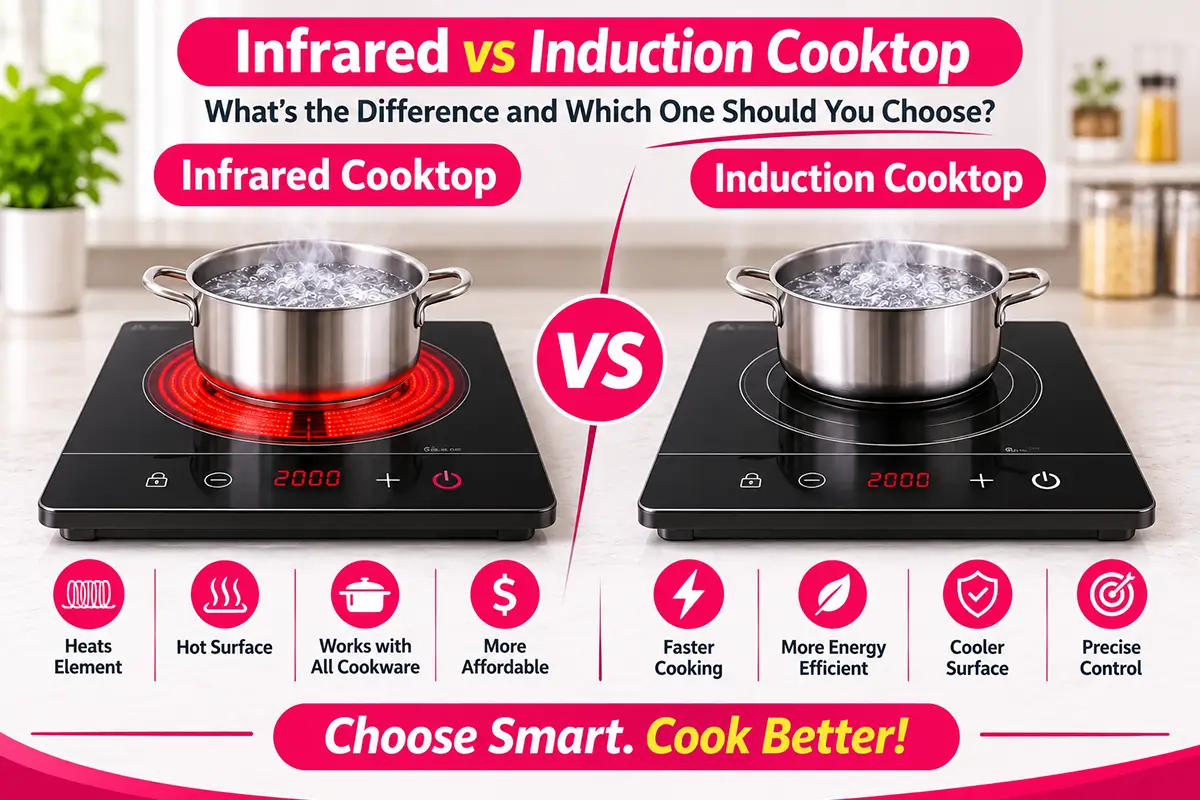
Modern kitchens are increasingly moving away from traditional gas stoves toward electric cooking technologies. Among the most popular options are infrared cooktops and induction cooktops. Both offer fast, convenient, and modern cooking, but they work in very different ways.
If you are planning to buy a new cooktop and are confused between infrared and induction, understanding how each technology works, its benefits, limitations, and differences can help you make the right choice.
What Is an Infrared Cooktop?
An infrared cooktop uses electric heating elements to generate heat. These heating elements become extremely hot and produce infrared radiation, which transfers heat to the cookware placed on the cooking surface.
The cooking surface usually becomes visibly hot and can glow red when operating at a high temperature.
Infrared cooktops can work with a wide range of cookware, including stainless steel, aluminum, glass, ceramic, and cast iron, as long as the cookware is suitable for the cooking surface.
How Does Infrared Cooking Work?
The process is simple:
- Electricity passes through a heating element.
- The element heats up.
- The element produces infrared radiation and transfers heat through the glass surface.
- Heat reaches the cookware.
- The cookware heats the food.
Because the heating element itself gets hot, the cooktop surface remains hot even after cooking.
What Is an Induction Cooktop?
An induction cooktop uses electromagnetic technology to heat the cookware directly. Instead of heating the cooking surface first, an induction cooktop generates a magnetic field that creates electrical currents inside compatible cookware.
These currents generate heat within the cookware itself, which then cooks the food.
How Does Induction Cooking Work?
The basic process is:
- Electricity flows through a coil beneath the glass surface.
- The coil creates a rapidly changing magnetic field.
- The magnetic field interacts with compatible cookware.
- Electrical currents are generated in the cookware.
- The cookware heats up and cooks the food.
The cooktop surface itself does not need to become extremely hot to generate cooking heat, although it can become warm from contact with the hot cookware.
Infrared vs Induction: Which Is Faster?
Induction cooktops are generally faster because they transfer energy directly into compatible cookware instead of first heating a heating element and cooking surface.
For example, when boiling water, an induction cooktop can typically bring water to a boil faster than an infrared cooktop under comparable conditions.
However, actual performance depends on the cooktop’s power rating, cookware size and material, and the amount of food being cooked.
Which Is More Energy Efficient?
Induction is generally more energy efficient than infrared cooking.
With induction, much of the energy is transferred directly to the cookware. Infrared cooktops first heat the heating element and cooking surface before transferring heat to the cookware.
This makes induction particularly attractive for people who want faster cooking and reduced energy loss.
Safety: Infrared vs Induction
Both cooktops can be safer than traditional gas cooking because they do not use an open flame.
However, their safety characteristics differ.
An infrared cooktop becomes very hot during operation and can remain hot for some time after switching it off.
An induction cooktop generally produces less residual heat on the cooking surface because the cookware is heated directly. However, the cookware itself can become extremely hot.
Therefore, neither technology should be treated as completely burn-proof.
Temperature Control
Induction cooktops usually provide more precise temperature control.
Because the electromagnetic field can be adjusted quickly, the cooking temperature can respond rapidly to changes in the selected power level.
Infrared cooktops also offer temperature control, but the heating element may take longer to cool down after reducing the heat.
Advantages of Infrared Cooktops
- Wide Cookware Compatibility: You generally don’t need specialized magnetic cookware.
- Affordable: Infrared cooktops are often available at a lower initial price.
- Simple Operation: They work similarly to conventional electric cooking and are easy to understand.
- Smooth Surface: The flat glass surface makes cleaning relatively easy.
- Suitable for Different Cooking Methods: Infrared cooktops can be used for boiling, frying, simmering, and other common cooking tasks.
Disadvantages of Infrared Cooktops
- The cooking surface becomes very hot.
- It may take longer to heat and cool.
- Energy efficiency is generally lower than induction.
- Heat transfer can be slower.
- Residual heat remains after switching the cooktop off.
Advantages of Induction Cooktops
- Fast Cooking: Direct heating of cookware allows for rapid cooking.
- High Energy Efficiency: More of the electrical energy is transferred directly to the cookware.
- Precise Temperature Control: Power adjustments can produce quick changes in cooking intensity.
- Improved Surface Safety: The cooking surface generally stays cooler than an infrared heating element, although it can still become hot from the cookware.
- Easy Cleaning: The flat glass surface is simple to wipe clean.
Disadvantages of Induction Cooktops
- Requires compatible cookware.
- Initial purchase price can be higher.
- Some cookware may need to be replaced.
- Certain models can produce a humming or buzzing sound.
- Performance can vary depending on cookware quality and size.
Infrared vs Induction: Which One Is Right for You?
The right choice depends on your cooking habits and priorities.
Choose Infrared If:
- You want a more affordable electric cooktop.
- You already have different types of cookware.
- You don’t want to replace your existing pots and pans.
- You prefer simple electric cooking.
- Cooking speed and maximum energy efficiency are not your top priorities.
Choose Induction If:
- You want faster cooking.
- Energy efficiency is important to you.
- You want precise temperature control.
- You are comfortable purchasing induction-compatible cookware.
- You prefer a cooking surface with less residual heat.
Final Verdict
Infrared and induction cooktops are both useful alternatives to traditional gas cooking, but they use fundamentally different heating technologies.
Infrared cooktops heat an electric element, which transfers heat to the cookware, while induction cooktops use an electromagnetic field to generate heat directly in compatible cookware.
If your priorities are fast cooking, energy efficiency, and precise control, induction is worth considering. If you prioritize lower initial cost and broad cookware compatibility, infrared can be a practical choice.
Before purchasing either type, compare the cooktop’s power rating, cooking zones, safety features, warranty, dimensions, and cookware compatibility rather than choosing based on technology alone.
💖Follow us for daily beauty tips, new arrivals, and exclusive offers!
Categories
Tags
- Appliances (2)
- Baby (1)
- Balanced Diet (1)
- Chemist at Play (1)
- Child (1)
- Conditioner (1)
- Cosmetics (5)
- COVID-19 (1)
- CSR (1)
- Customer Satisfaction (1)
- Customized Gift Set (1)
- E-commerce (4)
- Easy to Operate (1)
- Electrical (1)
- Electrical Appliances (3)
- Eye Serum (1)
- Family (1)
- Fashion (1)
- Female Hygiene (4)
- Gadgets (1)
- Gift Set (1)
- Glassware (1)
- Guide (1)
- Hair Care (2)
- Happy (1)
- Health (21)
- Heart Health (1)
- Home (1)
- Kit (3)
- Life (1)
- Lifestyle (28)
- Loved Ones (1)
- Made in Korea (1)
- Men (7)
- Menstrual Cup (1)
- Menstrual Hygiene (1)
- Moisturizers (2)
- Nepal (1)
- Offer (1)
- Patch Test (1)
- Pregnancy (1)
- Project (1)
- Purederm (1)
- Reduces Inflammation (1)
- Relatives (1)
- Serum (2)
- Shampoo (1)
- Skin Care (16)
- Skin Whitening (1)
- Skincare Mistakes (1)
- Skincare Routine (1)
- Stretch Mark Care (1)
- Sunscreen (1)
- Teej (1)
- Under Eye Serum (1)
- User Friendly (1)
- Web (1)
- Website (1)
- Women (24)